

How Things Work 2-minute video · ages 4-8 · free coloring page
How do parade balloons float?

Whoa, look up! How do parade balloons float?
 2 min
If the video does not start, use the YouTube button.
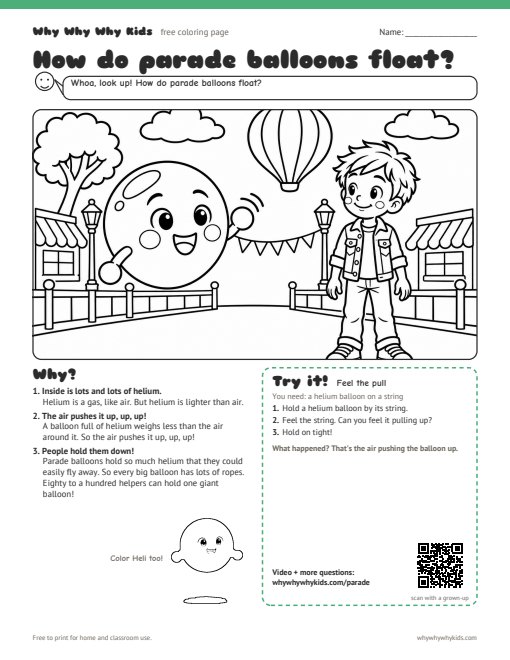
Print, color, try
Free coloring page
The scene from the video as a coloring page, plus the three-sentence answer, the experiment, and a QR code back to this page. One sheet, US Letter, black and white.
The answer in three parts
Why?
-

Inside is lots and lots of helium.
Helium is a gas, like air. But helium is lighter than air.
-
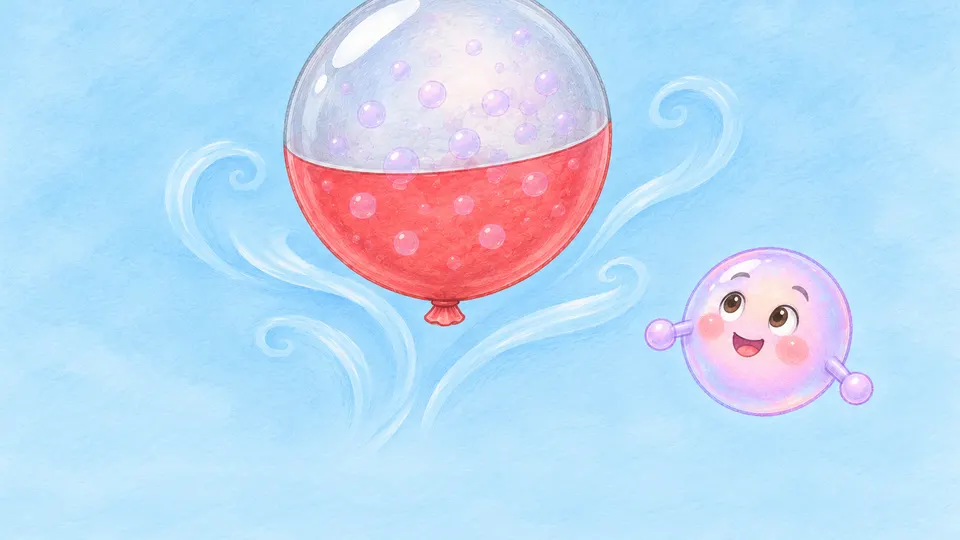
The air pushes it up, up, up!
A balloon full of helium weighs less than the air around it. So the air pushes it up, up, up!
-
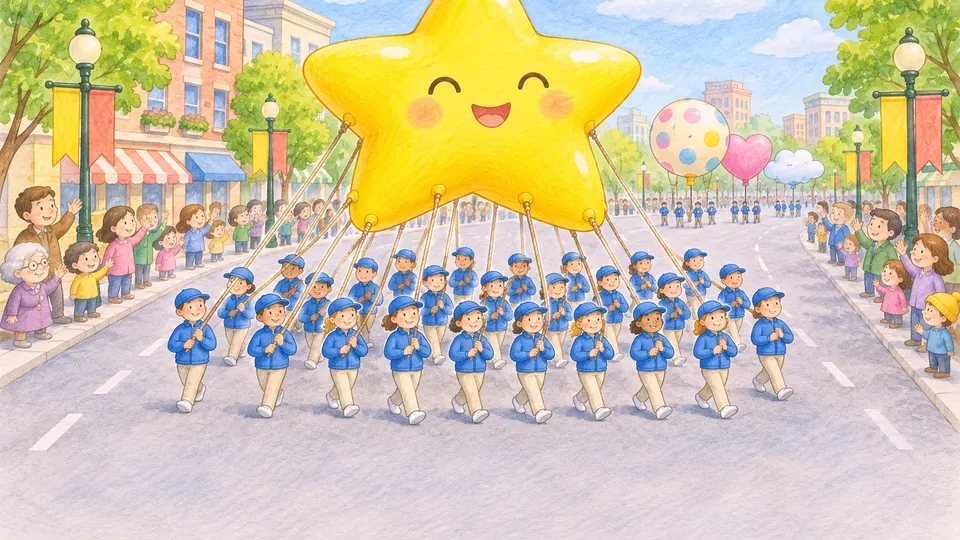
People hold them down!
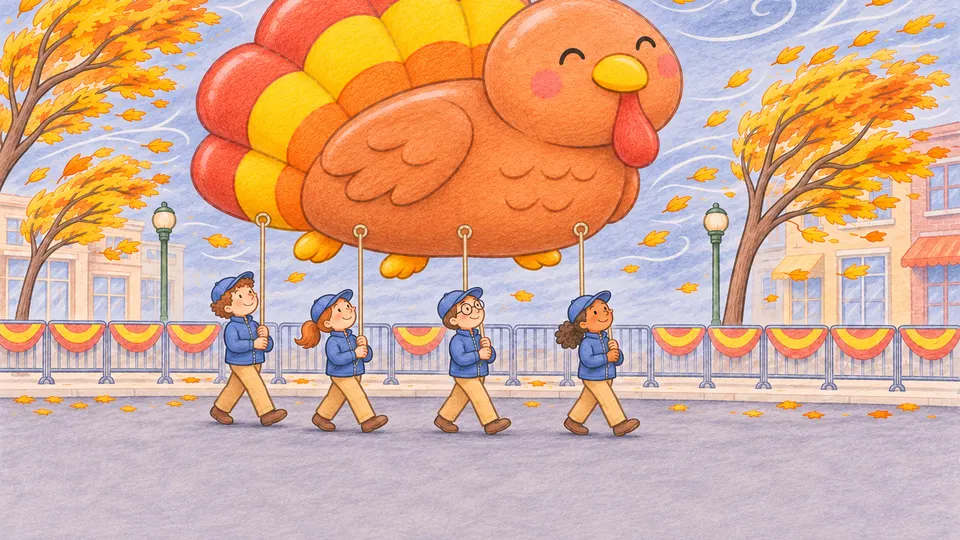
Parade balloons hold so much helium that they could easily fly away. So every big balloon has lots of ropes. Eighty to a hundred helpers can hold one giant balloon!
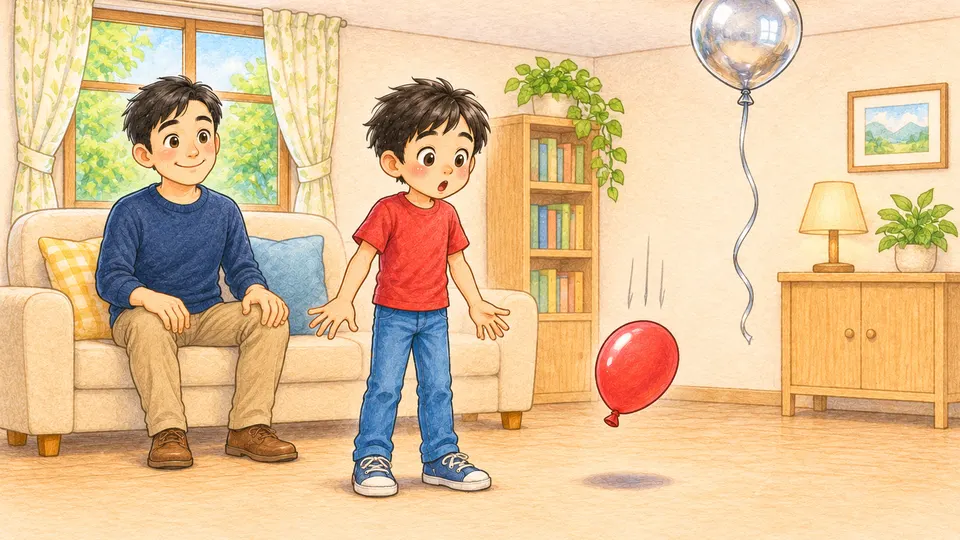
For grown-ups: It's a bit like a beach ball in a swimming pool: push it under the water, and the water pushes it right back up. When you blow up a balloon with your mouth, it's full of air, just like the air outside, so it doesn't float. On windy days, the helpers pull the balloons down low, close to the street. And if the wind is much too strong, the big balloons stay on the ground.
Why one floats and one falls
- Helium balloonlighter than the air around it
- Blown-up balloonfull of air like the air outside
- Beach ball in a poolthe water pushes it right back up
A tiny experiment
Try it!
Feel the pull
You need: a helium balloon on a string
- Hold a helium balloon by its string.
- Feel the string. Can you feel it pulling up?
- Hold on tight!
What happened? That's the air pushing the balloon up.

Did you know?
On windy days, the helpers pull the balloons down low, close to the street. And if the wind is much too strong, the big balloons stay on the ground.
On Thanksgiving morning, New York City has a big parade. Giant balloons float down the street, high above the people.
For teachers Grades K-2 · discussion and printables
A curiosity question with no matching K-2 NGSS performance expectation. It still works as a speaking-and-listening warm-up.
Use it in class
- Before the video. Ask: "Why do you think parade balloons float up?" Let them guess first: I think ... because ...
- Watch the 2-minute video together (it plays on the board through YouTube).
- After the video. Which guess was closest? Then ask: "How is helium different from air?" and "Why do parade balloons need so many helpers?" The three "Why?" points above have the answers. Do "Feel the pull" as a class demo.
- Color and explain. Hand out the coloring page (PDF); students tell a partner one thing they learned.
Words to know
- helium
- a gas that is lighter than air
- lighter
- weighing less
- ropes
- thick, strong strings
ELA: SL.K.2 / SL.1.2 / SL.2.2 - ask and answer questions about information presented in a video. More for class: teachers page · How Things Work question list.
Your guide in this video
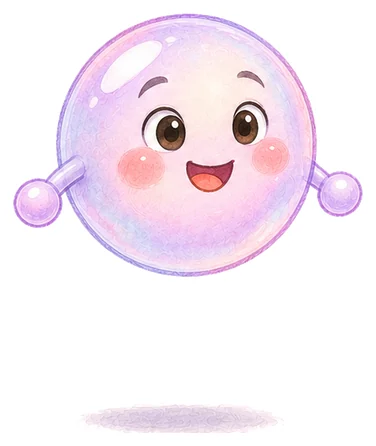
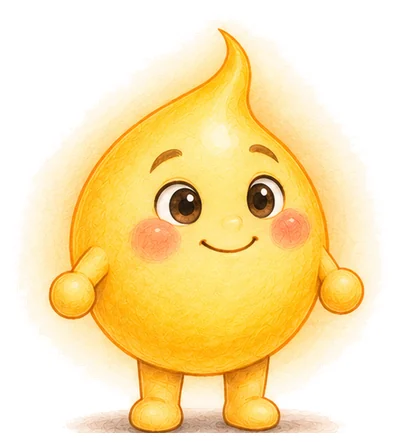
I'm Heli, a bit of helium. Let's find out!
Heli is a bit of helium, a gas that is lighter than air. That's why Heli floats!
Keep asking
Next question


How Things Work
Why does a balloon stick to my hair when I rub it?
with Zippy · 3 min
More from How Things Work





For grown-ups
Our videos are made for kids and play on YouTube. If your child watches in the YouTube Kids app with "approved content only", you can add our channel in three steps. See how.
No ads, no sign-up, no cookies, no tracking.