

My Amazing Body 3-minute video · ages 4-8 · free coloring page
Why does my tummy feel so full after a big dinner?

Oof! Tight like a balloon! Why does my tummy feel so full after a big dinner?

 3 min
If the video does not start, use the YouTube button.
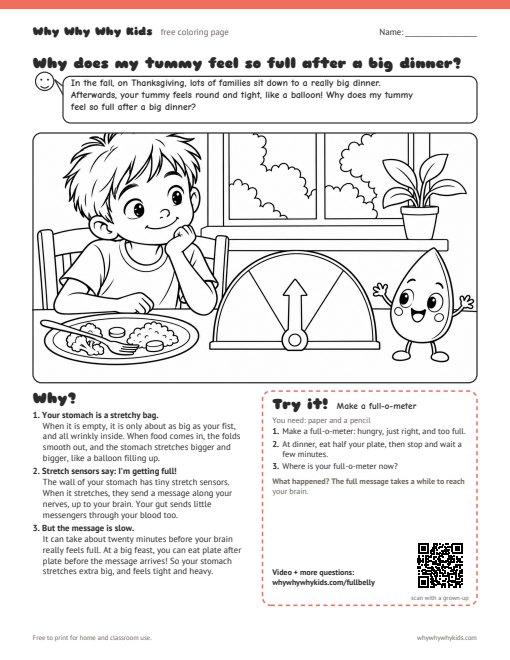
Print, color, try
Free coloring page
The scene from the video as a coloring page, plus the three-sentence answer, the experiment, and a QR code back to this page. One sheet, US Letter, black and white.
The answer in three parts
Why?
-
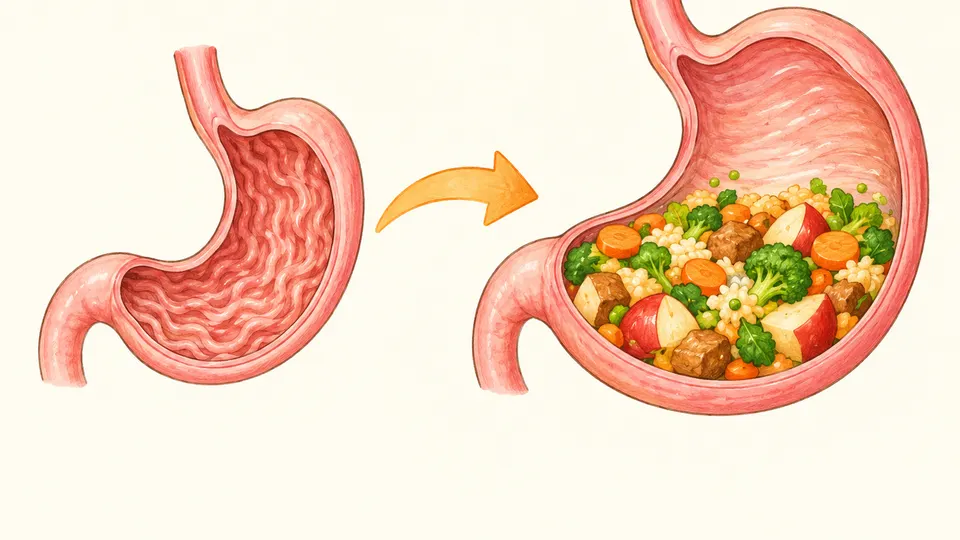
Your stomach is a stretchy bag.
When it is empty, it is only about as big as your fist, and all wrinkly inside. When food comes in, the folds smooth out, and the stomach stretches bigger and bigger, like a balloon filling up.
-
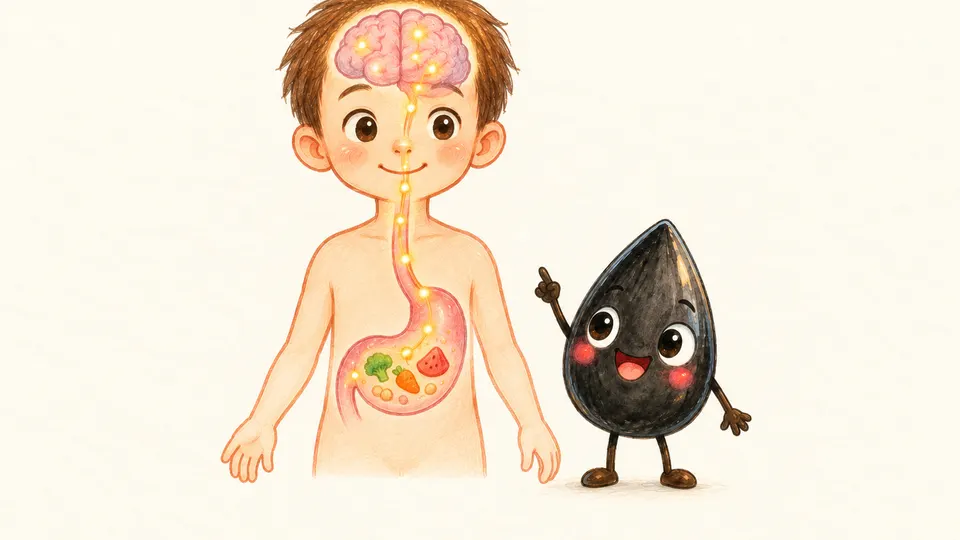
Stretch sensors say: I'm getting full!
The wall of your stomach has tiny stretch sensors. When it stretches, they send a message along your nerves, up to your brain. Your gut sends little messengers through your blood too.
-

But the message is slow.
It can take about twenty minutes before your brain really feels full. At a big feast, you can eat plate after plate before the message arrives! So your stomach stretches extra big, and feels tight and heavy.
For grown-ups: To feel just right: eat slowly, take small bites, and chew well. Wait a little before you take seconds. And after dinner, a short walk with your family feels good.
A tiny experiment
Try it!
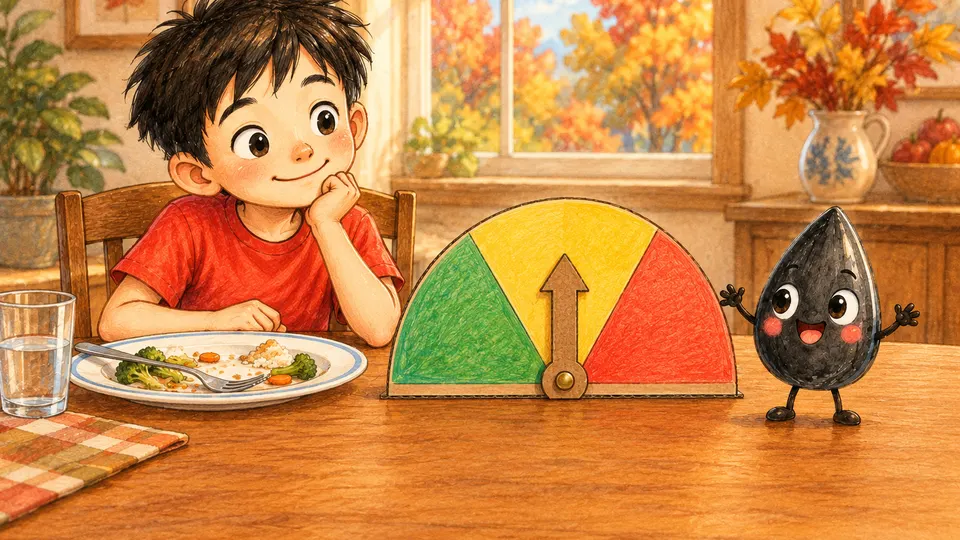
Make a full-o-meter
You need: paper and a pencil
- Make a full-o-meter: hungry, just right, and too full.
- At dinner, eat half your plate, then stop and wait a few minutes.
- Where is your full-o-meter now?
What happened? The full message takes a while to reach your brain.
Did you know?
Why is there always room for pie? When you eat lots of one food, your brain gets tired of that taste. A new, sweet taste seems exciting again, so you want a little more!
Your stomach's strong muscles squeeze and mix the food into a thick soup, and send it on, a little bit at a time. That takes a few hours, so the full feeling goes away slowly.

For teachers Grades K-2 · discussion and printables
No K-2 NGSS performance expectation covers this topic. Grades 3-5 connection: 4-LS1-2 (Animals take in information through their senses, the brain processes it, and the body responds.)
Use it in class
- Before the video. Ask: "How do you think your brain knows your tummy is full?" Let them guess first: I think ... because ...
- Watch the 3-minute video together (it plays on the board through YouTube).
- After the video. Which guess was closest? Then ask: "What happens to your stomach when food comes in?" and "Why can you keep eating before you feel full?" The three "Why?" points above have the answers. Do "Make a full-o-meter" as a class demo.
- Color and explain. Hand out the coloring page (PDF); students tell a partner one thing they learned.
Words to know
- stomach
- the stretchy bag in your body where food goes first
- sensors
- parts that notice a change and send a message
- nerves
- paths that carry messages to your brain
ELA: SL.K.2 / SL.1.2 / SL.2.2 - ask and answer questions about information presented in a video. More for class: teachers page · My Amazing Body question list.
Your guide in this video
I'm Seedy, a little watermelon seed. Your tummy's full message is super slow.
Seedy is a little black watermelon seed. Seedy's tummy ride is in our watermelon seed video.
Keep asking
Next question


My Amazing Body
Why does my tummy growl?
with Seedy · 3 min
More from My Amazing Body





For grown-ups
Our videos are made for kids and play on YouTube. If your child watches in the YouTube Kids app with "approved content only", you can add our channel in three steps. See how.
No ads, no sign-up, no cookies, no tracking.